Let’s be honest.
Most brands don’t have a messaging problem…
They have a say-too-much, mean-too-little, depends-who-you-ask problem.
Sales says one thing. Marketing says another. Leadership has a version that sounds strong in a boardroom but doesn’t always translate the same way in the real world.
And somewhere in the middle, your customer is thinking:
“Cool… but what do you actually do?”
Enter: the Message House.
What Is a Message House?
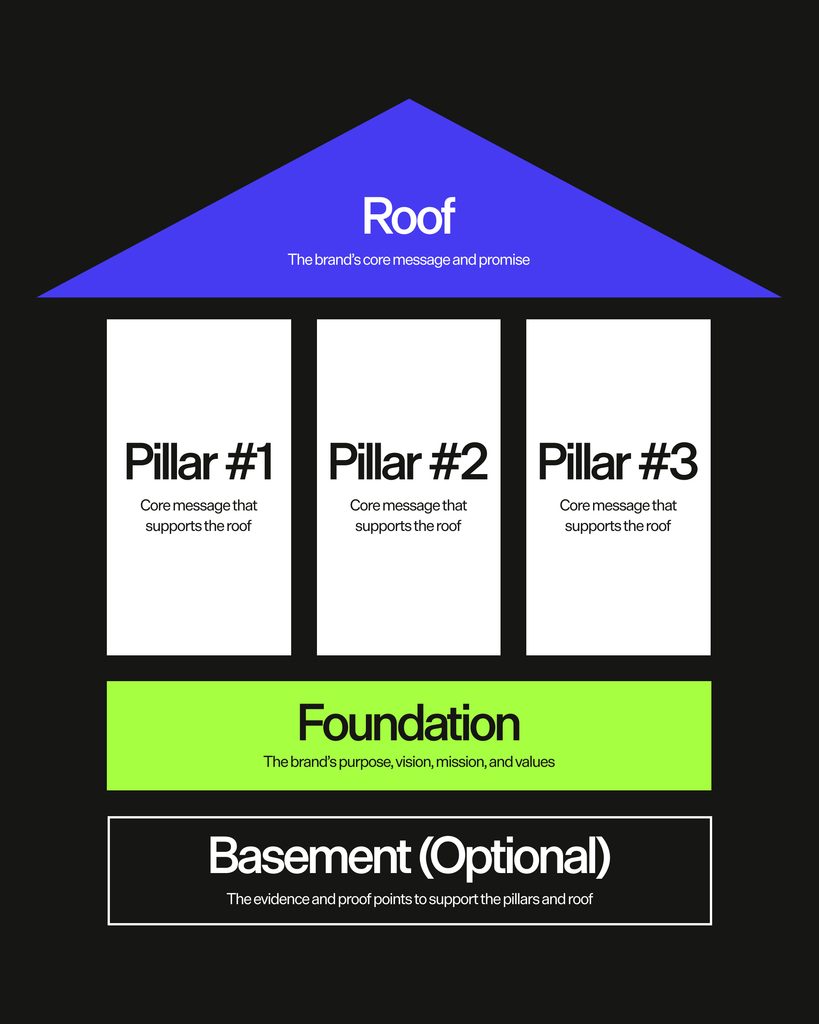
A message house is a one-page framework that organizes your company’s core messaging into a clear, structured narrative.
It’s typically made up of three parts:
The Roof: Your Core Message
This is the bread and butter. Your main idea. Your positioning. The clearest way to explain what you do and why it matters. All other messaging should support it, not compete with it. If someone remembers one thing about your company, it should be this. No pressure.
Most teams try to squeeze everything into this one line and end up with something that sounds important but says very little. A strong core message makes a choice. For example, instead of “we provide end-to-end supply chain solutions,” a SaaS company might say “we help supply chain teams make faster, more confident decisions with AI-powered optimization.” Same company, way easier to understand.
The Pillars: Your Key Messaging Themes
Usually three. Each pillar supports the roof and represents a distinct part of your value. If you pulled one into a sales conversation, it should still stand on its own.
Each pillar should clearly answer:
- What do we actually do here?
- Why does it matter?
- What problem does this solve?
If your pillars start to sound like reworded versions of the same idea, they’re not doing their job.
For example, a supply chain SaaS company might have pillars like:
- Real-time visibility: Gives teams a clear view of what’s happening across the network so they can respond faster and avoid surprises.
- Scenario planning: Helps teams model different outcomes and make better decisions before disruptions or changes hit.
- Operational efficiency: Enables teams to streamline inventory, reduce waste, and balance cost with service levels more effectively.
Each one focuses on a different stage of decision-making, but together they support the same core message.
The Foundation: Your Proof
This is where you back it all up. Because “we’re the best” doesn’t mean much without something behind it. This is where your messaging moves from claims to something people can actually believe.
For a supply chain SaaS company, this might look like:
- Reducing inventory by 20% without impacting service levels
- Running thousands of scenarios in minutes instead of days
- Improving forecast accuracy with real-time data inputs
It’s not just what you say, it’s what you can prove.
But here’s the part most people gloss over: the house is the final product. Before you ever get to the roof, pillars, and foundation, there’s real work involved—research, interviews, and figuring out what actually deserves a place in your messaging. We’ll break that down in a bit.
Why Your Brand Needs a Message House Strategy
If your messaging isn’t clear, you feel it everywhere.
Campaigns take longer because no one agrees on the angle.
Sales conversations vary depending on who’s leading them.
Your website tries to cover everything and ends up saying very little that sticks.
Internally, it shows up as constant rewrites, second-guessing, and “this doesn’t feel quite right” feedback. Externally, it shows up as confused prospects, longer sales cycles, and messaging that doesn’t quite land.
Over time, it becomes less about one bad headline or campaign and more about a lack of direction. Everyone is working hard, but not always toward the same message.
A message house is what brings that into focus. It gives your team a shared understanding of what you say, how you say it, and why it matters. So instead of reinventing the message every time, you’re building from something solid.
Who Needs a Message House? (Hint: Probably You)
Some companies feel this more than others. Usually, it shows up in small ways at first, then becomes a pattern you can’t ignore.
- B2B companies with complex or technical offerings
You’re doing impressive things. Explaining them is another story. Half your messaging sounds like a product manual, the other half sounds like a TED Talk.
- Startups that evolved quickly and never revisited their story
You’ve pivoted, expanded, maybe even rebranded… but your messaging is still hanging onto version 1.0 like it pays rent.
- Enterprise teams where messaging stretched across departments
Every team has “their version,” and none of them are wrong… they’re just not the same.
- Marketing teams tired of rewriting the same thing in five different ways
Homepage, sales deck, campaign copy… all slightly different, all taking longer than they should.
- Sales teams adjusting the pitch depending on the prospect
A little customization is fine. A completely different story every time? That’s a red flag.
If your message changes depending on who’s talking, what day it is, or how much coffee someone’s had… it’s time.
Benefits of a Message House
A good message house does more than clean things up. It changes how your team works and how your brand shows up day to day.
Consistency Across Every Channel
Your brand starts to sound like one company. From your website to your sales deck to your LinkedIn posts, everything pulls from the same source.
- Align messaging across website, sales, and social
- Create a more recognizable and trustworthy brand
- Eliminate conflicting or overlapping language
Faster Content Creation
You’re not starting from scratch every time. The thinking is already done.
- Reduce time spent rewriting and revising
- Start from a clear foundation, not a blank page
- Move campaigns and projects forward faster
Stronger Positioning In Your Market
You’re clearer about what makes you different, and you actually communicate it.
- Clarify your value in a crowded market
- Stand out from competitors with similar offerings
- Make your message easier to remember
Better Internal Alignment
Everyone is working from the same core message, which makes collaboration a whole lot smoother.
- Align marketing, sales, and leadership
- Cut down on back-and-forth edits
- Create a shared understanding across teams
More Confident Sales Conversations
When the message is clear, it’s easier to deliver and easier to believe.
- Deliver a more consistent pitch
- Make it easier for prospects to understand your value
- Build credibility through clear communication
What Goes Into Building a Message House?
This is where most people underestimate the work.
A message house looks simple when it’s done. Clean, structured, easy to follow. What you don’t see is everything that happens before you get there. You don’t just sit down and decide your messaging in an afternoon. We wish it were that easy!
Before the “house” ever takes shape, there’s real groundwork involved.
Discovery
This is where you get a clear view of what’s actually happening across your business, not just what’s written on your website.
- Stakeholder interviews to understand internal perspectives
- Customer interviews to hear how people describe you in their own words
- Market research to see where you fit and where you don’t
- A full audit of your current messaging and marketing
This is usually where patterns start to show up. It’s also where gaps become hard to ignore.
Defining the Strategy
Before writing a single line of messaging, it’s critical to get clear on a few things:
- Who your ideal customer actually is
- What problems matter most to them
- Where you’re truly differentiated
From there, you can build:
- ICP persona one-sheets
- A grounded SWOT analysis
- A clear positioning approach
This step matters more than people expect. If this part is off, everything that follows will be too.
Building the Message House
Once the groundwork is solid, the structure comes together:
- A core narrative that anchors your positioning
- Three messaging pillars with clear roles
- Pain points tied to each pillar
- Proof points that make it credible
Then it expands into something your team can actually use:
- Value proposition
- Elevator pitch
- Tagline options
- Short and long-form boilerplate
By the end, it’s not just a diagram. It’s a working system your team can use across your website, sales conversations, and campaigns.
How to Use a Message House After It’s Built
This is where it becomes valuable.
A message house is not something you build and file away. It should shape how your brand communicates across every touchpoint. Think of the message house as a filter. If something doesn’t align with it, it doesn’t go out.
A message house should show up in:
- Website copy
- Sales decks
- Campaign messaging
- Social content
- Product positioning
- Internal onboarding
Going back to the supply chain SaaS example, if the core message is about helping teams make faster, more confident decisions, your message house might show up in:
- A website headline focusing on real-time decision-making, not generic efficiency
- A sales deck structured around visibility, scenario planning, and efficiency
- A campaign highlighting how quickly teams can model scenarios and act
- A social post reinforcing one pillar through a real use case
- A product page showing how features drive better decisions
Ready to Build a Message House for Your Brand?
A message house should be more than a document your team references once and forgets about.
At PDG, we take a close look at how you’re talking about your brand, what’s working and what could be better. From there, we build messaging that reflects what makes your brand different and gives your team a consistent way to communicate it.
That includes:
- A clearer understanding of your ideal customer
- Stronger differentiation from competitors
- Messaging grounded in real customer insights
- Practical recommendations your team can actually use
Many of our longest-running client relationships started with a message house project. But once you get the clarity and see the impact, it’s hard to stop there. Because once your message is right, you don’t let it sit in a doc, you put it to work. That’s where we come in to bring it to life across your website, brand, and channels.
Ready for a pretty damn good message house? Let’s talk.